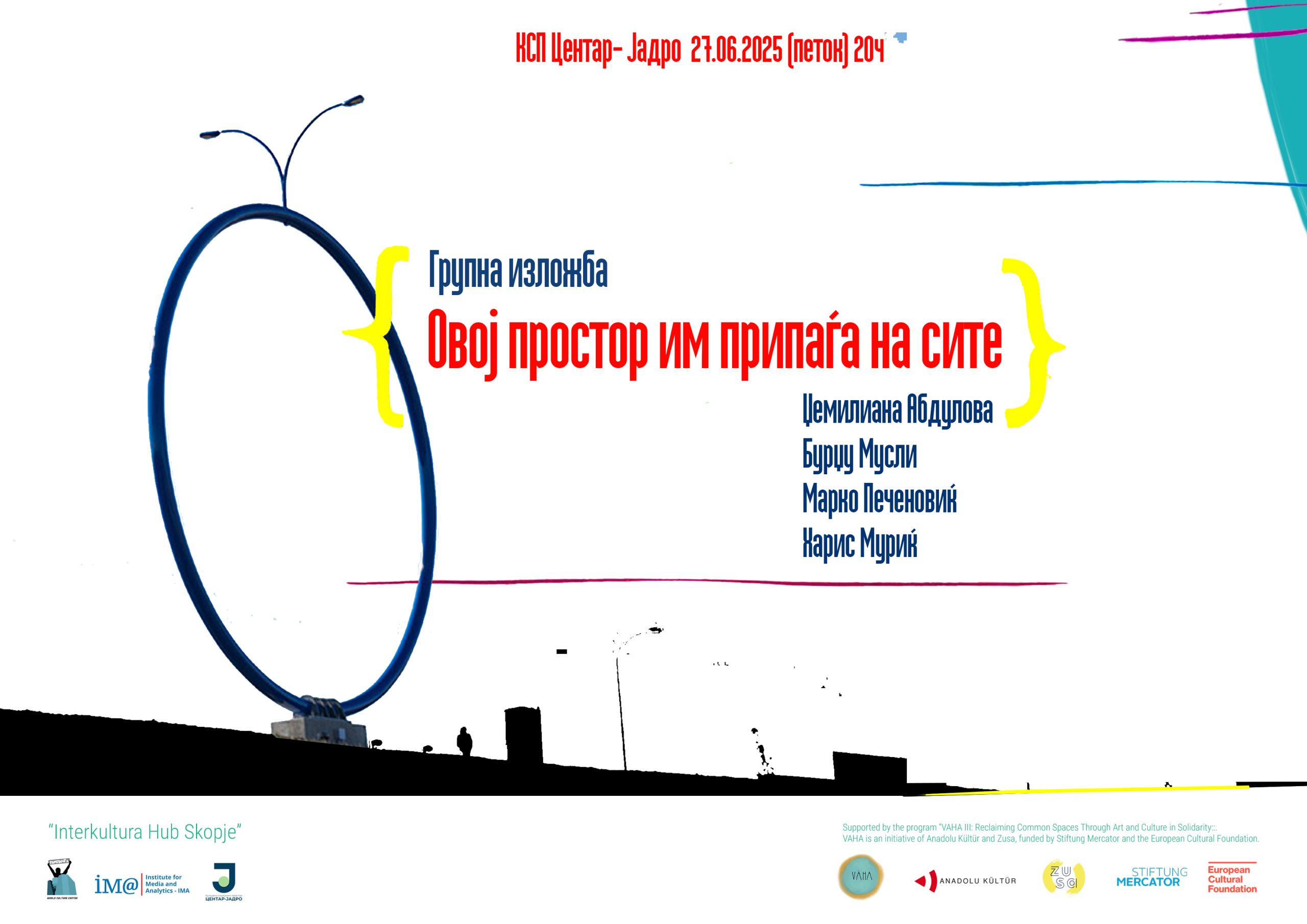
The group exhibition “This Space Belongs to Everyone”, which will open on June 27, 2025 (Friday) at 8 PM in Center Jadro Skopje, features works by four young artists that are presenting themselves together in this format for the first time. Džemiliana Abdulova, Burcu Musli, Marko Pečenović and Haris Murić, although each with their own specific poetics, in this exhibition are connected through their bold research and experimentation with intercultural, identity, gender and interdisciplinary layers of the contemporary, postmodern society.
In her works, Džemiliana Abdulova focuses on the Roma identity, Romanipe, which is a treasure trove of customs, history and everything that makes the Roma distinct and unique. Faced with the challenge of how to capture the spirit of a rich and diverse culture like that of the Roma, she uses the artivistic approach in her works, as a powerful tool through which she simultaneously confronts all the stereotypes and prejudices that abound in our patriarchal and traditional society. In her artistic practice so far, Džemiliana Abdulova has produced several experimental videos, is an illustrator of several books and the author of the work “A Small Roma Memory Book”. She was part of the cast of the Amateur Film Festival “Hidden Faces”, Romano Ilo and Romaversitas.
The themes that Burcu Musli chooses in her works are deeply connected to the culture of women from Eastern societies. She explores female identity, the perception of female sexuality and its understanding in patriarchal societies. She often uses folkloric and oriental symbols, fusing tradition with modernity. This duality creates a rich narrative that resonates with the past and present struggles of women in these regions. Burcu Musli is a multidisciplinary artist, a finalist for the prestigious “DENES” award, with two solo exhibitions of digital collages that address themes related to women’s rights and freedom, especially in Islamic cultures. She also works in photography, costume design and scenography. She intends to integrate dance and bodily expression into her artistic practice.
Haris Murić presents a selection of posters that are part of his project “When Do I Stop?”, in which he created one poster per week throughout 2024. This concept of his resembles a visual diary, in which he reflects various experiences and sensations from music, films and literature. In the cycle “When Do I Stop?”, Haris skillfully combines photography, collage, drawing, typography and poetry and through them deepens the meanings and layers of the poster, beyond the boundaries of its commercial purpose. Haris Murić is a graphic designer and visual artist with a diverse palette of artistic expression, which extends from visual identities, music covers, to posters. What he applies to the poster is his love for music, poetry, photography and nostalgia, expressed in a layout that gives meaning to all of them together.
In his works, Marko Pečenović combines painting, drawing and textual elements with a chaotic, layered aesthetic. Alienation, ghostly and fragmented forms speak of postmodern subjectivity, fragmentation of the self and media-induced alienation. The counterpointing of religious symbolism, media fragments and violent abstraction in Pečenović’s works could be interpreted as a commentary on post-Yugoslav identity, and the trauma of contemporary Balkan culture under global capitalist influence. Marko Pečenović is recognized in the alternative art scene as part of several bands and the collective “Gola planina” as a musician, poet and visual artist with a postmodernist sensibility.
The group exhibition “This Space Belongs to Everyone” is part of the project “Interkultura Hub Skopje” implemented by NGO Esperanza World Cultural Center, the Institute for Media and Analytics IMA and SCS Centar Jadro Skopje. Within the project, a special focus is placed on the culture of smaller communities as one of the most vulnerable and neglected parts of the cultural ecosystem in the country. For years, artists who cultivate the art and culture of smaller communities have not received sufficient support from the competent ministries. Without adequate support, the art and culture of smaller communities cannot truly develop. This endangers not only diversity as one of the key pillars of contemporary cultural policies recommended by UNESCO, but also multiculturalism as a feature and value of our society. With this exhibition, CSC Centar-Jadro and the project partners want to give these young, but proven artists a chance to present themselves more appropriately to the Skopje audience.
The project is supported by the program “VAHA 3: Reclaiming Public Spaces Through Art and Culture in Solidarity”. VAHA is an initiative of Anadolu Kültür and Zusa, funded by the Mercator Foundation and the European Cultural Foundation.
—