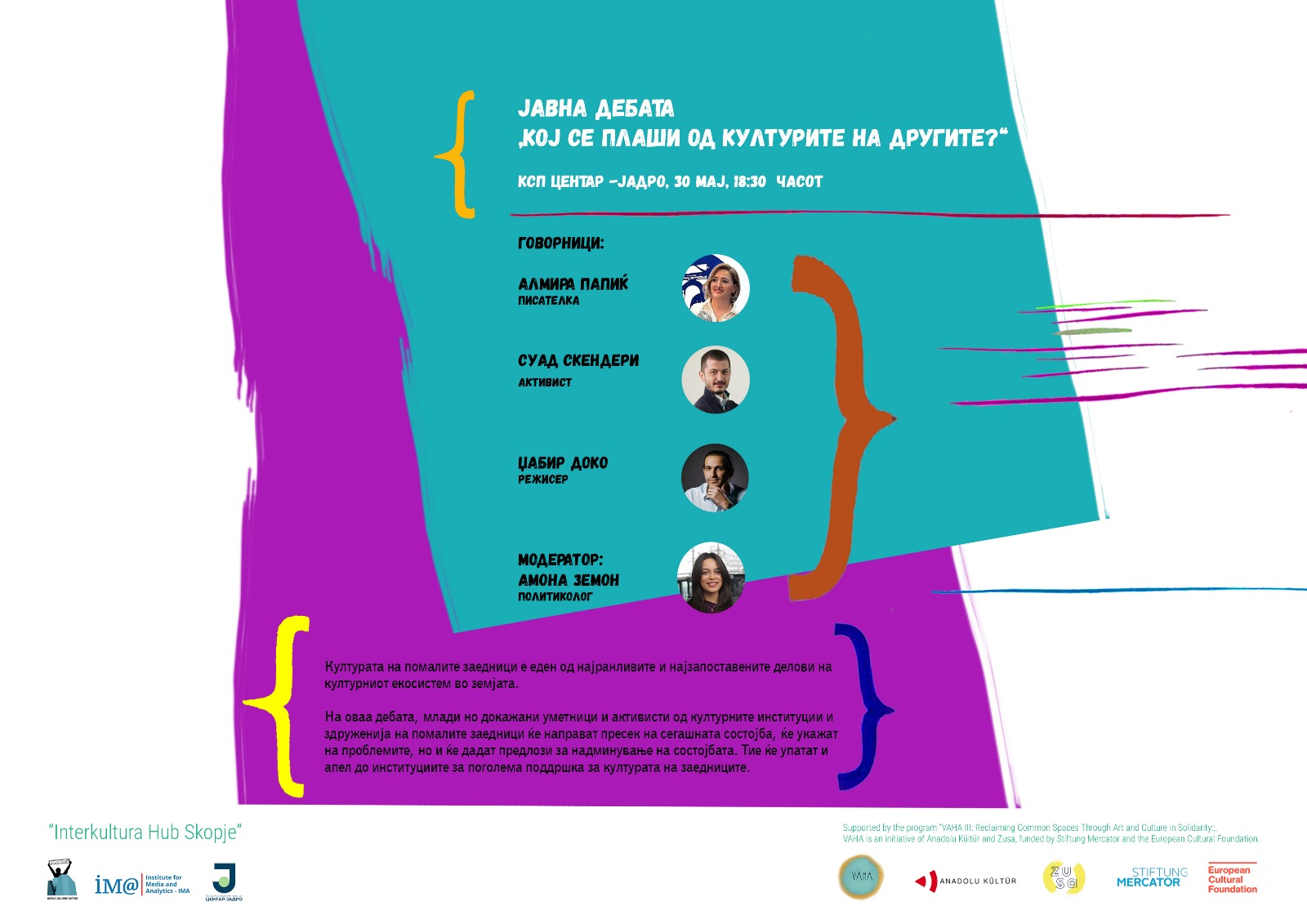
“Who’s Afraid of the Cultures of the Others?” is the topic of the public debate, which will take place at the Social and Cultural Center Jadro in Skopje this Friday (May 30, 2025), starting at 6:30 PM. The speakers at this event are Almira Papić, Suad Skenderi and Djabir Doko. The debate will be moderated by Amona Zemon.
The culture of smaller communities is one of the most vulnerable and neglected segments of our cultural ecosystem. Artists and associations who have nurtured it for years emphasize the lack of real support from both the state and international foundations. While initiatives such as the Decade of Roma Inclusion and the One Society and Interculturalism Strategy do exist, capacity building remains slow, organizations stagnate, and plans for cultural institutions of the communities are continually postponed. Without systemic support, this kind of art cannot truly flourish; ceremonial celebrations and occasional small projects are insufficient for the ambitions of these artists and cultural workers. This endangers not only cultural diversity as a key pillar of UNESCO’s cultural policies, but also multiculturalism as a fundamental value of our society.
At this debate, young and established artists and activists from cultural institutions and associations of smaller communities will provide an overview of the current situation, point to the challenges, and propose solutions for improvement. They will also issue an appeal to institutions for greater support for community cultures.
Almira Papić is a teacher, publicist and editor, known for her dedication to the affirmation of the Bosnian language and culture in North Macedonia. She is the author of several works, including the first Macedonian-Bosnian dictionary. Editor of the only Bosnian-language newspaper “Šadrvan”, which is an important platform for multicultural dialogue. With her engagement, Papić leaves a deep mark in education and literature.
Suad Skenderi is one of the founders of the Institute for Policy Research and Analysis – Romalitiko and the manager of the Politics program. He graduated in political science, international relations and journalism from FON University, and later obtained a master’s degree from the Central European University in Budapest in political science with a specialization in research methodology. He was a researcher at ThinkYoung in Brussels, Roma Integration 2020 in Belgrade, and coordinator of the European Roma Institute for Arts and Culture for Macedonia. Before founding the institute, he worked at the Humanitarian and Charitable Association of the Roma – “Mesečina” – Gostivar as an assistant in the human rights and interethnic relations sector, and then as a coordinator for youth initiatives. His work has been noted in many scientific journals, research, books, op-eds and other works.
Djabir Doko is a theatre director with long-standing experience in human rights activism, democracy, and cultural diversity. His work focuses on the Turkish community in North Macedonia, but he also actively follows the challenges faced by other ethnic communities in the areas of education, cultural, and institutional representation. For two years, he served as a deputy minister in the Ministry for Inter-Community Relations, where he worked on strengthening the rights and visibility of communities. He deeply believes in the power of art and collective activism as tools for social change.
Amona Zemon, political scientist with a focus on human rights and non-discrimination. Until recently, she was engaged at the Council of Europe in Strasbourg, where she worked in the field of protecting the rights of national minorities and minority languages. She is developing her academic engagement at the University of Graz, Austria, in the master’s programme in Southeast European Studies. Her approach combines research dedication with practical involvement, with the aim of contributing to more just, inclusive, and democratic societies.
The public debate “Who’s Afraid of the Cultures of the Others?” is part of the project Intercultural Hub Skopje, implemented by Esperanza – World Cultural Center, the Institute for Media and Analytics IMA, and Center Jadro Skopje, supported by the VAHA 3 programme: Reclaiming Public Spaces through Arts and Culture in Solidarity. VAHA is an initiative by Anadolu Kültür and Zusa, funded by the Mercator Foundation and the European Cultural Foundation.
—